
Executive Coaching and Leadership Support for Organisations
Sustainable Performance Under Pressure
Through coaching, workshops, and facilitated conversations for founders, leaders, and teams.
I help reduce friction, improve communication and decision-making, and support more sustainable ways of working.
Based in Barcelona, working internationally.
Support
Executive & Sustainable Performance Coaching
Neurodiversity-Informed Leadership Support
Team Communication & Working Styles Sessions
Leadership & Manager Workshops
HR & Leadership Advisory Sessions

What Organisations Are Seeing
By the time burnout, conflict, absence or resignation is visible, the pattern has usually been building for some time.
Earlier signs are often quieter:
capable people becoming less consistent
managers avoiding difficult conversations
communication creating more work than clarity
meetings multiplying while decisions slow down
too much depending on too few people
In founder-led businesses and fast-moving teams, a few capable people often hold the context, absorb the pressure, and compensate for unclear systems until their own capacity starts to erode.
These aren’t always individual performance problems. They may be signs that pressure, load, communication and support are out of balance, and it is time to look closer.
Performance Depends on Human Capacity
Organisations depend on human capacity: the cognitive, emotional and physical resources people draw on to think clearly, communicate well, recover properly and adapt under pressure.
When the conditions that support performance weaken, performance may continue for a while, but it becomes fragile. People rely on urgency, overwork, hidden effort and a few key individuals holding too much together.
Future capacity is the ability of people, teams and organisations to keep performing well tomorrow because the conditions that support performance are protected today.
Borrowing From Future Capacity
Output can continue while judgement, trust, recovery and clarity are being depleted.
In the short term, that can look like commitment…
… over time, it becomes fragility.
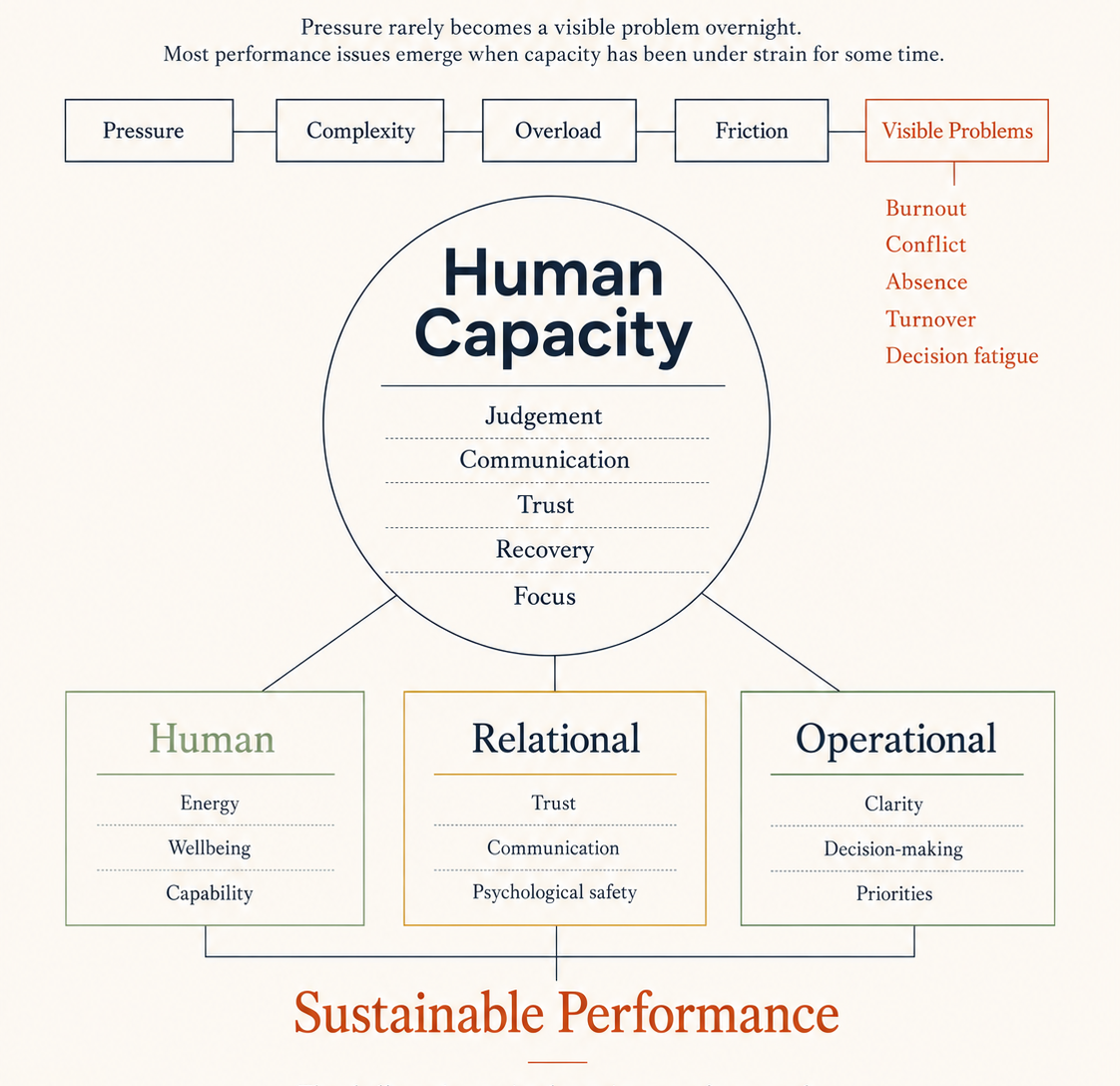
A common pattern looks like this:
The question isn’t just:
How do we get more out of people?
It’s:
What conditions help people stay at their best without being depleted by the way we work now?
How I Support Organisations
Organisations face different challenges, but the patterns are familiar: capable people carrying too much, managers navigating increasing complexity, and teams struggling with clarity under pressure.
Executive and Sustainable Performance Coaching
For founders, senior leaders and key staff whose performance, judgement or wellbeing is being affected by high pressure.
Coaching helps people navigate complexity, reduce overload and sustain performance without relying on overextension.
Common themes include leadership pressures, decision fatigue, burnout risk, communication challenges, ADHD, autism and other neurodivergent ways of working.
Neurodiversity-Informed Leadership Support
For managers and HR or People teams supporting cognitively diverse employees and colleagues.
This work helps organisations move from awareness of the issues towards practical approaches to communication, performance, workplace adjustments and support.
The aim is to help managers lead with greater confidence, clarity and effectiveness while reducing avoidable misunderstandings and friction.
Team Working Styles and Communication Workshops
For teams experiencing friction, overload, misunderstanding or unclear expectations.
These facilitated sessions make communication patterns, assumptions and ways of working more visible, helping collaboration become easier and reducing unnecessary friction.
Common themes include communication issues, role clarity, decision-making, meeting overload and differing working styles.
Examples of Where This Work Can Help
These are examples of situations organisations bring to coaching, workshops and team conversations.
Overloaded founder
When too much context, decision-making and responsibility sits with one person, creating overload and system bottlenecks.
Manager under pressure
When communication, workload and competing demands make management feel reactive rather than intentional.
Team experiencing friction
When misunderstandings, unclear expectations or differing working styles are creating unnecessary effort and slowing progress.
What This Work Helps To Protect
When pressure is left unmanaged, the costs rarely appear immediately. They emerge later as absence, conflict, stalled communication, poor decisions and the loss of trusted people.
This work helps protect the conditions that allow capable people and teams to perform well over time.
It can help:
protect decision quality under pressure
reduce friction around expectations
reduce friction across different working styles
retain knowledge, trust and capacity
reduce burnout and overload risk
improve communication and collaboration
support high performers sustainably
increase manager confidence
The goal is not simply to help people cope with pressure. It is to create the conditions for clear thinking, effective collaboration and sustainable performance under pressure.

My Approach
Performance problems rarely sit in one place.
A person may be struggling, but the cause may also involve an unclear role, a strained relationship, a system not supporting the work, or expectations that have outgrown available support.
I work where person, role, relationship and system meet. That means paying attention to the individual and the surrounding conditions: communication, workload, expectations, trust, decision-making and support.
Not to help people tolerate unsustainable conditions or turn managers into therapists.
The aim is to make pressure, load, communication and working patterns more visible, discussable and workable, so people and teams can make better choices about what needs to change.
My approach draws on executive coaching, systems thinking, systemic modelling, clean language and neurodiversity-informed practice. In practice, that’s careful listening, clear questions and grounded conversations about how work is really happening.
What I pay attention to
Person
capacity, confidence, judgement, regulation
Role
expectations, priorities, responsibility, authority
Relationship
trust, communication, conflict, repair
System
workload, culture, incentives, support
What would make things easier to see, discuss and work with?
Start With a Focused Conversation
If your organisation’s navigating overload, leadership pressure, neurodiversity questions, communication friction or burnout risk, we start with a conversation about what you see.
The first step is not to commit to a programme. It is to understand the pattern clearly enough to decide what kind of support may be useful.