What accrediting as a Professional Executive Coach means to me
I’m really pleased to have been recently accredited as a Professional Executive Coach by the Association for Coaching. Thank you to Rosie Sweetman, who ran my live assessment, and to Claire Reid, from the Association’s accreditation team, who guided me through the process of applying and submitting all the relevant evidence.
My Professional Executive Coach badge from the Association for Coaching
For me, this is more than an additional credential. It formally recognises the professional experience and development I have accumulated since qualifying as an executive coach in 2014.
Since then, I have completed around 1,000 hours of coaching with clients, including senior professionals, founders, entrepreneurs, creatives and people navigating demanding roles or significant transitions in their lives.
Those hours have taught me that capable people rarely struggle because they lack intelligence, ambition or commitment. More often, their capability is constrained by overload, competing demands, unclear priorities, invisible options, unsustainable environments or ways of working that do not fit how they think and function.
The accreditation process gave me an opportunity to consolidate what I have learned, examine how my practice has evolved and articulate more clearly the coach I am becoming.
Developing a neuroinclusive practice
My original executive coaching training provided strong foundations in contracting, listening, reflection, challenge and supporting purposeful action. Since then, my practice has become increasingly neuroinclusive.
My diagnoses of ADHD in 2021 and autism in 2023 fundamentally changed my understanding of my own life and work. They helped me recognise patterns that had previously been interpreted as inconsistency, poor discipline or personal failure. They also required me to examine my own biases as a coach.
Shared neurotype does not mean shared experience. My understanding of ADHD and autism from within can help me recognise challenges relating to executive function, cognitive load, emotional regulation, sensory experience, communication and burnout. But it can also create a risk of assuming that another person’s experience resembles mine.
This has strengthened my commitment to curiosity, humility and careful attention to each client’s own language and understanding of themselves.
I developed this work further through the Postgraduate Certificate in Neurodiversity Coaching at Birkbeck, University of London. The programme deepened my understanding of coaching psychology, neurodiversity, Clean Language, intersectionality, epistemic safety and the importance of avoiding assumptions based solely on diagnostic labels.
Neuroinclusive coaching is not simply conventional executive coaching with additional knowledge about ADHD or autism. It means remaining aware of my assumptions and leading with curiosity, particularly around motivation, productivity, communication, accountability and progress.
A structure that creates clarity for one person may overwhelm another. A challenging goal may motivate one client and trigger paralysis in another. Accountability can support action, but it can also recreate experiences of judgement or failure.
My role is often to help clients understand the conditions under which their capability becomes accessible and sustainable within their lives.
Experience, judgement and continued learning
The accreditation recognises my experience, but coaching hours alone do not create professional maturity. What matters is the judgement developed through practice, supervision, reflection and continued study.
I have learned, and am still learning, when to offer structure and when to create more space. When challenge is useful and when it risks pushing past something important. When to trust my intuition. When a practical solution is needed and when moving too quickly towards action would prevent deeper understanding.
I have also become more aware of the limits of my knowledge.
Professional confidence does not mean pretending to know exactly what is happening for another person. It means bringing experience, care and challenge at the right moment, while remaining fully open to being wrong.
I am proud of this accreditation because it recognises twelve years of development and around 1,000 hours of client work.
It also represents a commitment to continue learning, refining my practice and becoming a better executive coach.
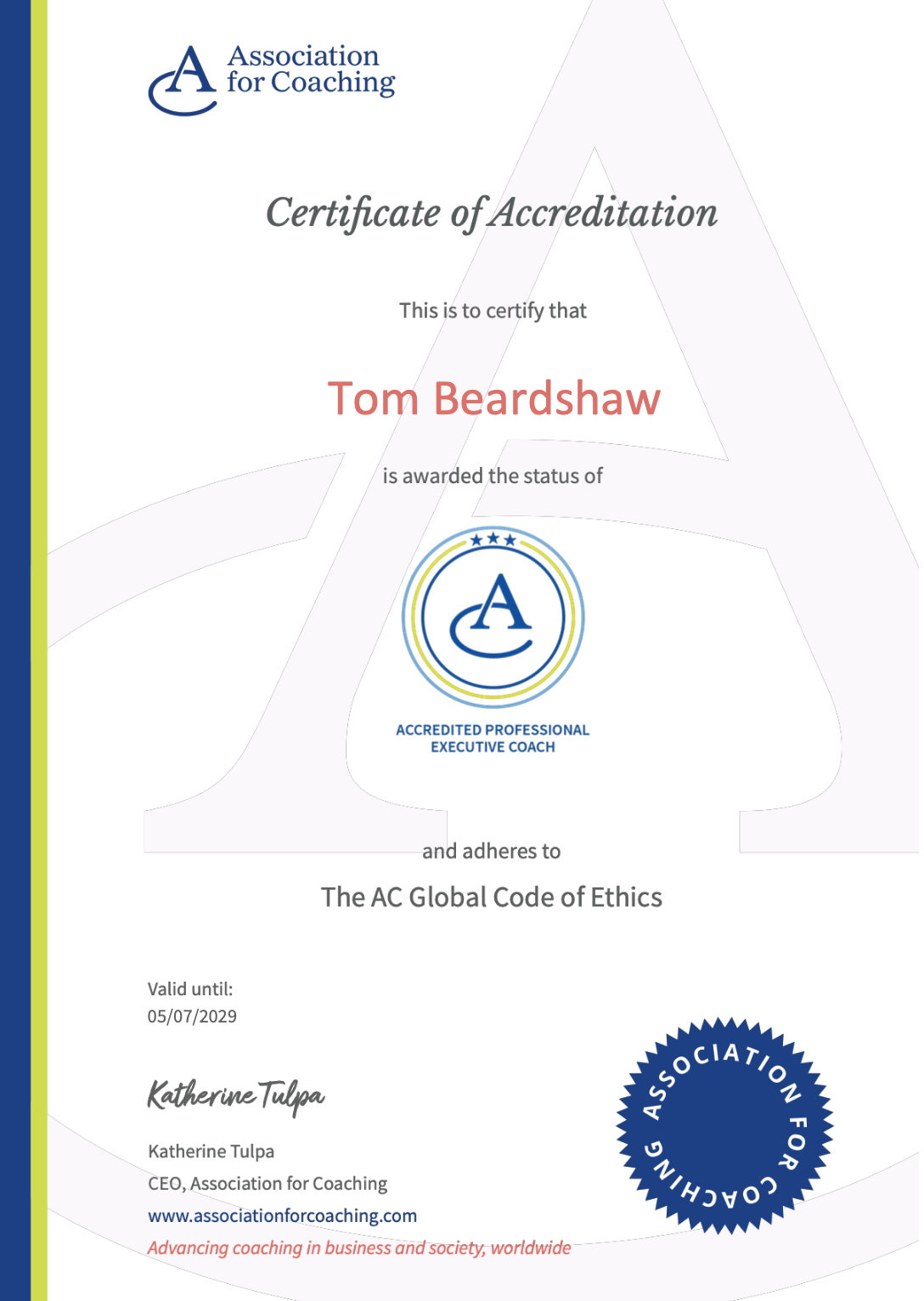
My Accreditation Certificate 😊