Sustainable Ambition Part 3: Designing for Adaptive Capacity
What adaptive organisations do differently
This series began with a simple argument: many organisations are achieving results by consuming their future capacity.
Part 1 asked where that capacity is being consumed. Part 2 asked what invisible loads are carried, by whom, that organisations fail to see. Part 3 asks whether work can be redesigned so capacity is not merely protected, but grown.
Sustainable ambition is not about avoiding pressure. Leaders still have to lead. Founders have to build. Teams have to deliver. The question is whether organisations can create value under pressure without destroying their ability to do so again.
The future will not belong simply to organisations that move fastest, automate most or extract the greatest effort. It will belong to those that create value while growing the human, relational and organisational capacity they will need next.
The conditions have changed
We are entering an economy where codified knowledge, competent analysis and first-pass creative work are becoming easier to produce. Generative AI and agentic systems can already perform parts of many professional roles. Jobs will be transformed, but the distribution of risk, power and reward is not fixed.
As information and plausible answers become cheaper, advantage shifts. It no longer belongs mainly to whoever knows most, but to systems that can judge, coordinate, test, learn, take responsibility and adapt.
AI does not enter neutral organisations. In systems that already reward speed, availability and visible activity, it may create more communication, options, analysis and demand than people can absorb. Rather than relieving cognitive overload, it may accelerate it.
The danger is not only replacement. It is that organisations use new tools to intensify old patterns: more output, speed, monitoring and complexity, with less time to understand what any of it means.
So the old question, “How do we get more output from people?”, becomes less useful than a harder one: “How do we build systems that keep adapting, deciding and learning without degrading the people inside them?”
Prediction still matters, but adaptability matters more. Adaptation depends on feedback. Feedback depends on honest information. Honest information depends on trust. Repeated adaptation also needs spare capacity and recovery.
Sustainable performance is therefore not a wellbeing add-on. It is the infrastructure that allows organisations to keep learning under pressure.
The loop is familiar: act, learn, adapt. What matters now is whether the conditions around that loop allow it to stay honest.
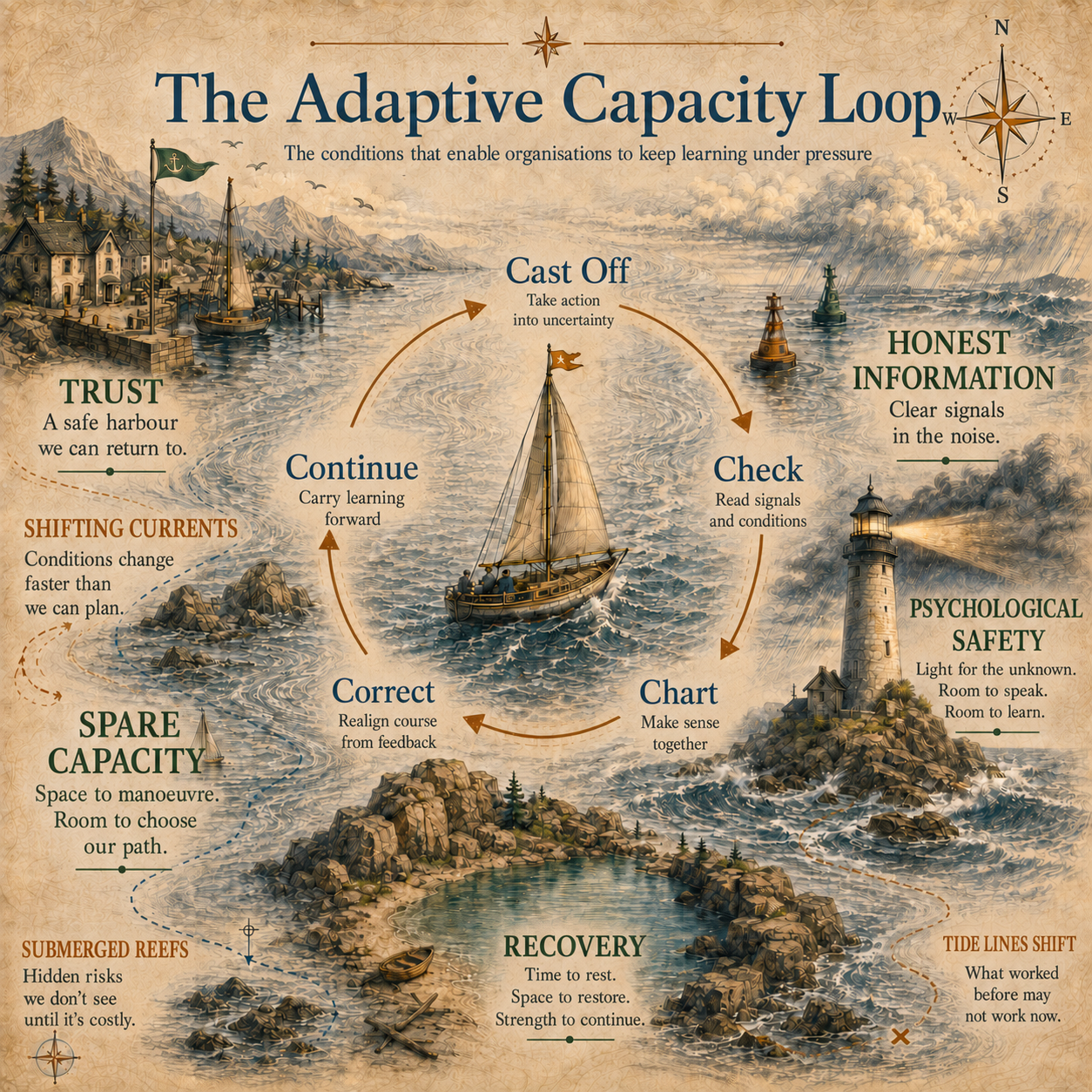
The Adaptive Capacity Loop: action only becomes learning when organisations support the conditions that enable sensing, interpreting, adjusting and recovering.
Speed is not learning
A business owner recently put this vividly: when events move too quickly to predict, value may go to those willing to put on their armour and charge before the perfect moment appears.
There is truth in this. Waiting for certainty can become paralysis. But charging forward does not make the direction correct, especially if the organisation cannot learn rapidly from what happens next.
In businesses and charities I’ve built, I’ve known the intoxicating feeling when things are moving quickly: new opportunities, urgent decisions, everyone looking to you for momentum and direction. At times, speed felt like evidence that the thing was alive. But I’ve also had to learn that when there is no space to review, recover or hear inconvenient information, speed starts to conceal weakness rather than create strength. Sooner or later, the system reveals what has not been learnt.
The loop only works if the organisation can sense reality quickly, interpret it honestly, adjust without excessive defensiveness, and recover enough to act again. When those conditions break down, an organisation may still move quickly, but it stops learning accurately.
Sustainable performance is not the opposite of speed. It is what makes repeated, intelligent action possible.
Pressure is not the same as growth. It becomes useful only when paired with recovery, feedback, meaning and support. Without those conditions, pressure becomes damage, repetition or isolation.
Four forms of ambition
This is where the word ambition needs more precision. Ambition is not one thing. It can consume capacity, withstand pressure, learn from pressure, or grow capacity while creating value. I distinguish four forms:
Fragile ambition is achieved by consuming future capacity. It depends on overextension, urgency, masking, self-abandonment or private collapse.
Robust ambition can withstand pressure. It has enough structure and resources to keep functioning, but may still be organised mainly around endurance.
Antifragile ambition learns through difficulty. Pressure is paired with recovery, feedback and adaptation.
Sustainable ambition goes further. It grows human, relational and organisational capacity while creating value. It protects judgement, trust and adaptability, but also develops them. It asks not only, “What can we achieve?” but, “What are we becoming as we achieve it?”
This is the form of ambition I am most interested in: not ambition reduced, but ambition matured.
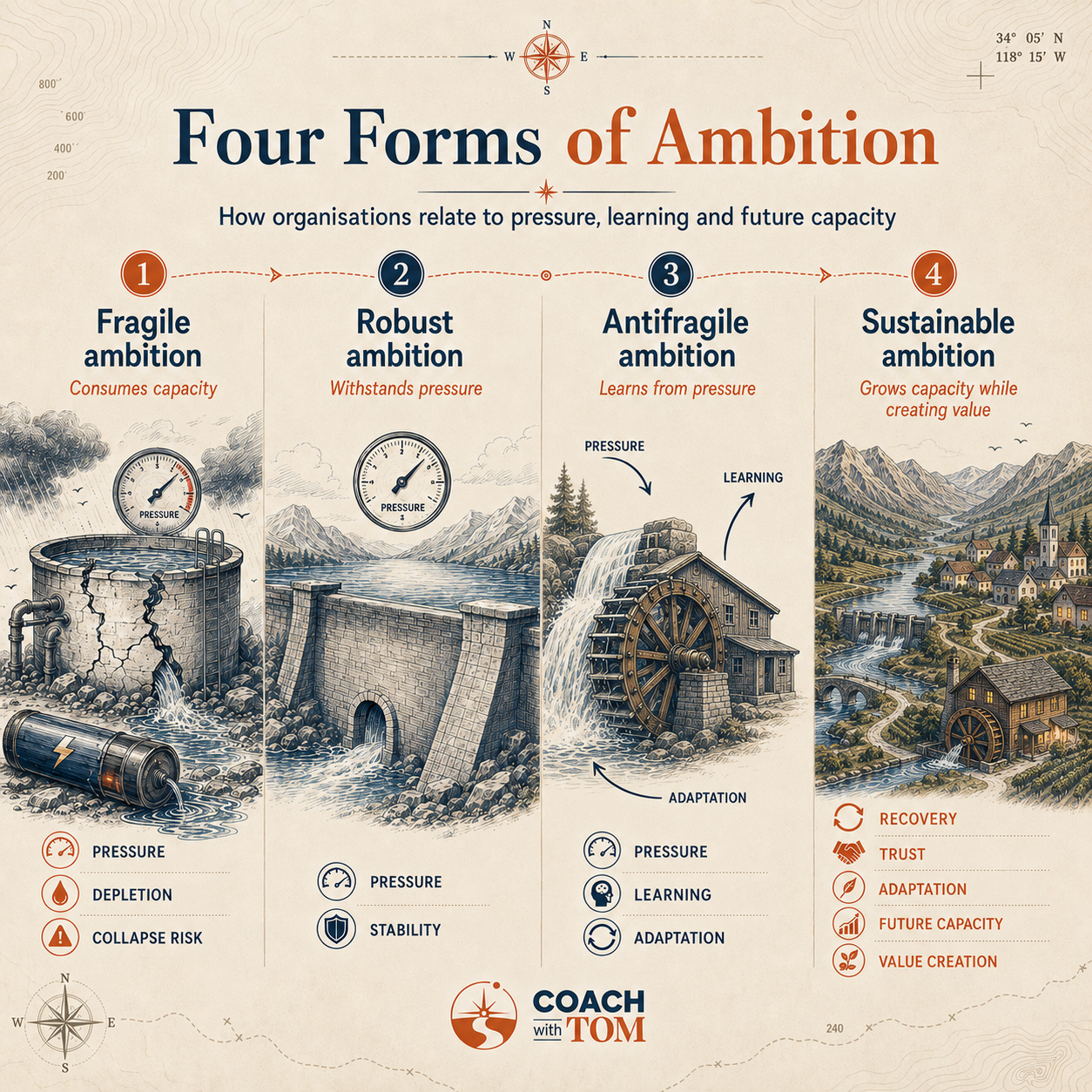
Four forms of ambition: from systems that consume future capacity to systems that grow capacity while creating value.
The shift from fragile to sustainable ambition is not a shift from hard work to easy work. It is a shift from extraction to regeneration: from asking how much pressure people can tolerate, to asking what kind of system helps people, teams and organisations become more capable over time.
Systems shape people
Organisations do not merely produce products, services and returns. They shape the people inside them.
Culture is not only what an organisation says it values. It is what the system repeatedly makes easier, safer and more rewarding.
A system that rewards permanent urgency develops people who treat everything as urgent. A system that protects senior leaders from consequences weakens perspective and accountability. If uncertainty is punished, people perform certainty. If bad news is punished, people manage appearances. If only visible speed is rewarded, people learn to move faster than they can think.
The question is not only what a system produces. It is what it trains people to notice, reward, tolerate and become. Above all, it is whether the system makes reality easier to reveal or easier to hide.
In uncertain conditions, this becomes strategic. Hidden reality is delayed adaptation. When organisations fail to learn from what people are noticing, some of those most able to detect system friction may leave in order to design work around themselves.
Sustainable performance is designed
Adaptive organisations do not rely on better intentions. They design different conditions.
Four questions make this practical:
Can the organisation sense reality quickly?
Short feedback loops, reversible experiments, worker voice, friction treated as data.
Can people tell the truth early?
Psychological safety, manager skill, non-punitive escalation, honest disagreement.
Can people coordinate clearly?
Explicit priorities, decision rights, meeting discipline, communication norms.
Can the system recover enough to keep adapting?
Protected focus, recovery cycles, realistic workload, capacity-aware planning.
Some neurodiversity-informed organisations already build this into governance: pattern-seeking incident logs, risk registers that reduce reliance on memory, clean feedback processes, clear decision rights and escalation routes.
These are not bureaucratic extras. They make reality easier to see, disagreement easier to hold, and responsibility less dependent on individual heroics.
In uncertain environments, cognitive difference is not merely something to accommodate. Different ways of noticing, questioning, sensing risk and finding patterns can improve an organisation’s ability to detect what its dominant assumptions miss. The 2026 Neurodiversity in Business and Birkbeck report describes this as “neurodiversity gain”: the wider benefit created when systems, processes and cultures are redesigned with neurodivergent people in mind.
In practice, this means making priorities, roles and decision rights explicit; allowing meaningful job crafting where the work permits it; protecting concentrated work; designing meetings around decisions, learning or connection; preserving enough slack to respond when reality changes; and treating friction, errors and burnout as information about the system.
In AI-enabled work, this also means involving workers in design. Clarity, trust, training, voice and managerial support shape whether technology expands capability or intensifies control.
If AI saves time, does that time become recovery, learning, better service and shorter work, or is every gain immediately converted into higher targets? Who receives the upside, and who absorbs the uncertainty?
Sustainable ambition is not about removing pressure. It is about designing systems that can keep learning under pressure without consuming the people, trust and judgement that learning depends on.
A fragile system treats time saved as spare capacity to extract. People produce more, faster, while review, judgement and recovery shrink. A more sustainable system allocates the gain intelligently: faster service where it matters, but also clearer review points, worker input, learning time and explicit discussion of what remains humanly accountable.
The point is not to slow the work. It is to make speed safer, more intelligent and more repeatable.
Organisational design cannot resolve the wider distribution of wealth and power on its own. But within any institution, it can either reproduce those dynamics uncritically or create meaningful limits, voice and shared benefit.
The question remains: is this system increasing its capacity to act and learn, or consuming that capacity to maintain today’s output?
A higher ambition
Sustainable ambition is not a softer version of business. It is more demanding because it refuses to treat human capacity as free, infinitely renewable or someone else’s problem. It asks leaders to take responsibility not only for what their organisations produce, but for what their organisations make possible.
Its hope is practical rather than sentimental.
AI could remove drudgery, widen access to knowledge and create more time for care, creativity, judgement and relationship. It could also concentrate wealth, weaken bargaining power and accelerate existing extraction. Technology does not decide between those futures. Institutions, incentives and choices do.
So the questions facing leaders are changing.
What would help your organisation keep learning under pressure?
I work with leaders, teams and organisations to make pressure, working patterns and future capacity more visible
Which human capacities does this organisation consume, and which does it grow?
Who benefits from greater productivity, and who carries the risk?
What would it mean for work to leave people, teams and communities with more capacity than they had before?
No organisation can guarantee that it is moving in the right direction.
But it can design itself to keep seeing, learning, adapting and caring enough to find a better one.
References & Influences
International Labour Organization, Generative AI and Jobs: A Refined Global Index of Occupational Exposure
International Monetary Fund, Gen-AI: Artificial Intelligence and the Future of Work
UNCTAD, Technology and Innovation Report 2025: Inclusive Artificial Intelligence for Development
Daron Acemoglu and Simon Johnson, Power and Progress: Our Thousand-Year Struggle Over Technology and Prosperity
World Inequality Lab, World Inequality Report and World Inequality Database
Amy C. Edmondson, Psychological Safety and Learning Behavior in Work Teams
Amy C. Edmondson, The Fearless Organization
Chris Argyris and Donald Schön, Organizational Learning II: Theory, Method, and Practice
Catherine S. Burke, Kevin C. Stagl, Eduardo Salas, Linda Pierce and Dana Kendall, Understanding Team Adaptation: A Conceptual Analysis and Model
Nassim Nicholas Taleb, Antifragile: Things That Gain from Disorder
Evangelia Demerouti, Arnold Bakker, Friedhelm Nachreiner and Wilmar Schaufeli, The Job Demands–Resources Model of Burnout
Nancy Doyle, Neurodiversity at Work: A Biopsychosocial Model and the Impact on Working Adults
Nancy Doyle, Learning from Neurodivergent Leaders: How to start, survive and thrive in Leadership
Nancy Doyle and Almuth McDowall, Neurodiversity Coaching: A Psychological Approach to Supporting Neurodivergent Talent and Career Potential
Almuth McDowall and Aishwarya Srinivasan, Neurodiversity in Business: Research Report 2026: Neurodiversity Gain, Inclusive Practice and Self-employment
CIPD, Neuroinclusion at Work Report, 2024
Golo Henseke, “Generative AI at Work: From Exposure to Adoption across 35 European Countries”