Sustainable Ambition Part 1: When High Performance Becomes Fragile
Why leaders need to protect future capacity
Many organisations still confuse intensity with ambition.
Intensity is not inherently a problem. Ambitious work does sometimes requires urgency, focussed effort and periods of exceptional commitment. The distinction is whether that intensity is chosen, time-bounded and properly resourced, with adequate recovery afterwards, or whether it becomes chronic, imposed and treated as the ‘normal operating model’.

High performance becomes fragile when an organisation sustains momentum by consuming the human capacity it needs for the future.
Speed, responsiveness, resilience and commitment can all be valuable. They become fragile when they depend on persistent overextension rather than adequate resources, meaningful control and recovery. The language is impressive: agility, pace, ownership, high standards, the extra mile. But beneath it, something more fragile is also happening.
The senior leader answering Slack messages at midnight isn’t always demonstrating commitment. They may be showing us an organisation that has lost the ability to distinguish urgency from importance.
People can perform by overriding themselves.
Masking fatigue, suppressing stress signals, fragmenting attention, responding to every interruption as if it were a test, and carrying levels of complexity the system itself has failed to organise for.
For a while, this can produce impressive results.
Until it doesn’t.
A system that routinely drives results by exhausting its people is borrowing from its future. So-called high-performance culture becomes a short-term mirage.
Many companies now operate in ways that look productive quarter to quarter while quietly degrading the judgement, attention, trust and adaptability they’ll later depend on.
Ambition and wellbeing are often framed as a trade-off. That misses the point.
The more serious issue is this:
What if we shouldn’t see wellbeing as a reward for ambition achieved, but a baseline condition that allows that ambition to become sustainable, adaptive and genuinely strong?
Fragile ambition
I've been reflecting on Nancy Doyle's work and a question that sits at the heart of neurodivergent leadership: how do we hold ambition and wellbeing together?
Her work matters because she asks a radical question: what if success isn’t achieved by sacrificing wellbeing to ambition, but only by learning how to hold the two together?
That question matters far beyond neurodiversity.
Capability and vulnerability often overlap. Creativity can come with overload sensitivity, deep focus with difficulty switching, and pattern recognition with frustration at ambiguity. High capability and high vulnerability are often consequences of the same human complexity.
The same individuals can be both highly capable and easily damaged by an unsuitable environment.
This is not just a neurodiversity issue. It’s a systems issue. Poor work design may impose costs earlier or more acutely on some neurodivergent people because the demands hit executive functioning, sensory processing, emotional regulation and cognitive load harder and sooner.
But the pattern is a wider one.
Fragile ambition is success achieved by consuming the resources needed for future success. It looks impressive in the short term because it creates rapid output, growth or recognition. But it drains the human systems that make future performance possible.
We see it in organisations that have stopped measuring sustainable performance and started measuring visible endurance. The long-term vision gives way to short-term survival.
We see it in leaders admired for their availability while their family relationships, health and attention quietly deteriorate.
We see it in some neurodivergent founders, executives and solopreneurs whose excellent work may be sustained through masking, over-preparation and chronic anxiety, while the resulting exhaustion or loss of functioning remains largely invisible to others..
Many senior professionals now spend their days in continuous partial attention: six meetings, three or four messaging platforms, constant context switching, and no uninterrupted thinking time until late evening or the weekend.
At the same time, many people are carrying anxiety about employability, relevance and future security as AI continues to reshape work. When people feel they must constantly demonstrate their value or remain permanently available to avoid becoming replaceable, organisations unintentionally erode their capacity for future performance in the pursuit of short-term visibility.
In some organisations, senior people spend entire days reacting rather than thinking, then reserve strategic judgement for the exhausted final hour of the evening.
Then organisations wonder why judgement deteriorates.
Fragile ambition isn’t a lack of ambition.
It’s ambition without solid human infrastructure.
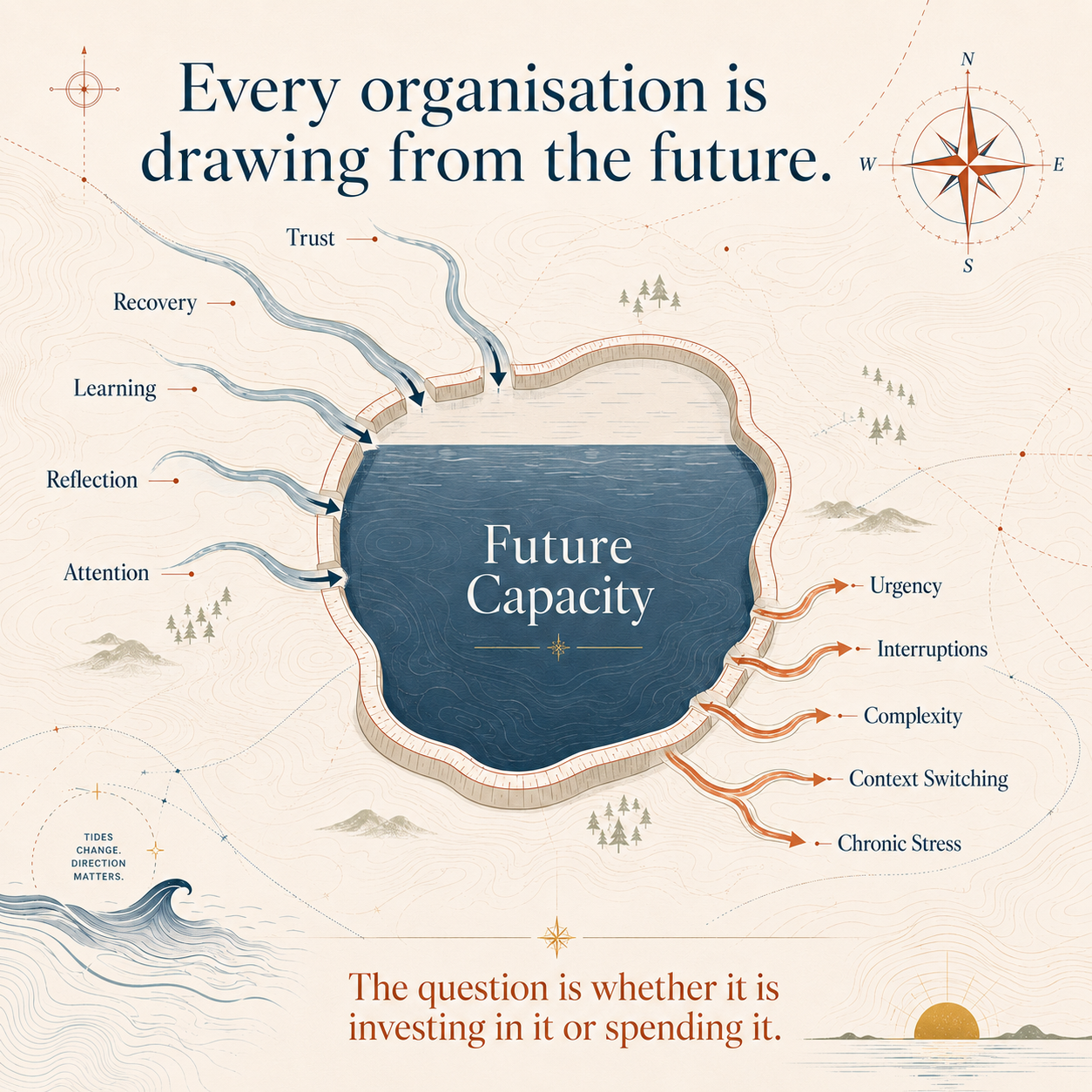
Future Capacity: A key asset in an AI economy?
Future capacity
This brings me to an idea I keep returning to: future capacity.
It’s the ability of a person, team, family, organisation or community to keep adapting, deciding, relating, recovering, creating and regenerating over time. It isn't a single thing. It emerges from the interaction of human and organisational resources: attention, trust, rest, recovery, reflection, learning, adaptability and the ability to keep making good decisions under pressure.
Future capacity is different from conventional productivity measures, which compare output with the inputs used to produce it. It asks a different question: whether today’s performance is preserving or depleting the human and organisational resources needed to perform tomorrow.
Both matter. But short-term productivity figures can conceal costs that have simply been deferred. If we ignore the impact of today’s working practices on our future capacity, we misread performance entirely.
We treat visible output as the whole story and miss the real costs. We admire endurance without asking what’s being endured, who’s enduring it, and whether it needs to exist at all.
The depletion of future capacity is expensive, even when organisations don’t measure it directly.
It shows up as declining decision quality, slower adaptation, rising conflict, increased attrition, less innovation, defensive communication, duplicated work and talented people quietly disengaging before they resign.
Teams become more reactive, less reflective, and increasingly dependent on hypervigilance to maintain momentum.
This is where the language of wellbeing can feel too soft for the seriousness of the issue.
Human flourishing, recovery, psychological safety, clear communication and sustainable working conditions aren’t perks. They’re part of the regenerative capacity of serious organisations.
They protect judgement, trust, reflection, learning and future capacity itself.
Ironically, the rise of AI may make human capacity more valuable rather than less. As routine tasks become cheaper and easier to automate, judgement, trust, creativity, collaboration, learning and adaptation become more important, not less.
In an environment shaped by AI, automation and accelerating change, future capacity may become one of the most important competitive advantages an organisation can possess. The winners are unlikely to be the organisations that extract the most effort from people today. They are more likely to be the organisations that preserve enough attention, trust, learning, adaptability and sound judgement to keep responding intelligently to what comes next.
Burnout as system feedback
Burnout is often treated primarily as an individual health issue, which can obscure what it may reveal about the conditions of work.
Not that individuals have no agency. People still need boundaries, regulation, prioritisation and self-awareness. Coaching can help with all of that, and does.
Here I am using burnout primarily in the occupational sense. The World Health Organization describes occupational burnout as resulting from chronic workplace stress that has not been successfully managed.
Autistic burnout is a related but distinct phenomenon, involving profound exhaustion, reduced functioning and reduced tolerance to stimuli. The two can overlap, particularly where masking and poorly matched environments are involved, but they should not be treated as interchangeable.
But people can’t self-regulate their way out of unsafe, exploitative or chronically under-resourced systems.
Christina Maslach and Michael Leiter’s work has long emphasised that burnout isn’t only about workload. It’s also about control, reward, community, fairness and values.
The Job Demands-Resources model makes a similar point: high demands deplete energy, while resources such as autonomy, support, clarity and feedback protect engagement and reduce exhaustion.
Burnout is rarely just a private failure of resilience.
It’s often a signal that demands and resources have become dangerously misaligned, and it matters commercially.
Burnout reduces creativity, communication quality, retention and decision-making. When leaders and staff are dysregulated, organisations become less intelligent.
Leaders under sustained cognitive and emotional strain become more reactive, less curious, more threat-sensitive and less capable of nuanced judgement.
They may still move fast, but achieving speed by degrading future capacity looks nothing like wisdom under complexity.
What leaders can begin to notice
Are you investing or spending?
This is the first question I'd invite leaders to ask:
Where are we consuming future capacity faster than we're regenerating it?
The answer may lie in individual habits, team dynamics, organisational design, or all three.
So the issue for leaders isn’t whether people are coping today, but whether the way success is being achieved is increasing or depleting the capacity needed to succeed tomorrow.
Because every organisation is drawing from the future.
The big question is whether it's investing in it or spending it.
References and influences
Is your organisation relying on hidden overextension to sustain performance?
I work with leaders, teams and organisations to make pressure, capacity and working patterns more visible and workable.
Nancy Doyle, “Neurodiversity at Work: A Biopsychosocial Model and the Impact on Working Adults”
Nancy Doyle, Learning from Neurodivergent Leaders
Christina Maslach and Michael Leiter on occupational burnout and the areas of worklife
Demerouti, Bakker, Nachreiner and Schaufeli on the Job Demands–Resources model
Raymaker and colleagues on defining autistic burnout
World Health Organization, “Burn-out an Occupational Phenomenon”