Sustainable Ambition Part 2: Invisible Loads & What Organisations Don't See
What remains unseen
In the first article in this series, I argued that many organisations are borrowing from their own future.
They’re achieving results by consuming the human capacity they’ll later need for judgement, trust, creativity and adaptation.
But there’s another layer to this.
Some of the most important pressures are invisible to the systems that depend on people carrying them.
This article is about those hidden demands, who carries them, and what organisations miss when they fail to see them.
Organisations see meetings attended, messages answered, deadlines met, a professional tone maintained.
They don’t measure the cognitive costs of translation, masking or holding family life together before the working day even begins.
They don’t see the recovery that never happened.
They don’t see the effort required to appear calm inside cultures shaped by ambiguity, constant interruption and underlying social pressure.
Invisible loads are still loads.
And when organisations fail to see them, they misread both performance and risk.
Neurodivergent people are often among the first to feel these pressures, and their experiences can reveal what organisations struggle to see.
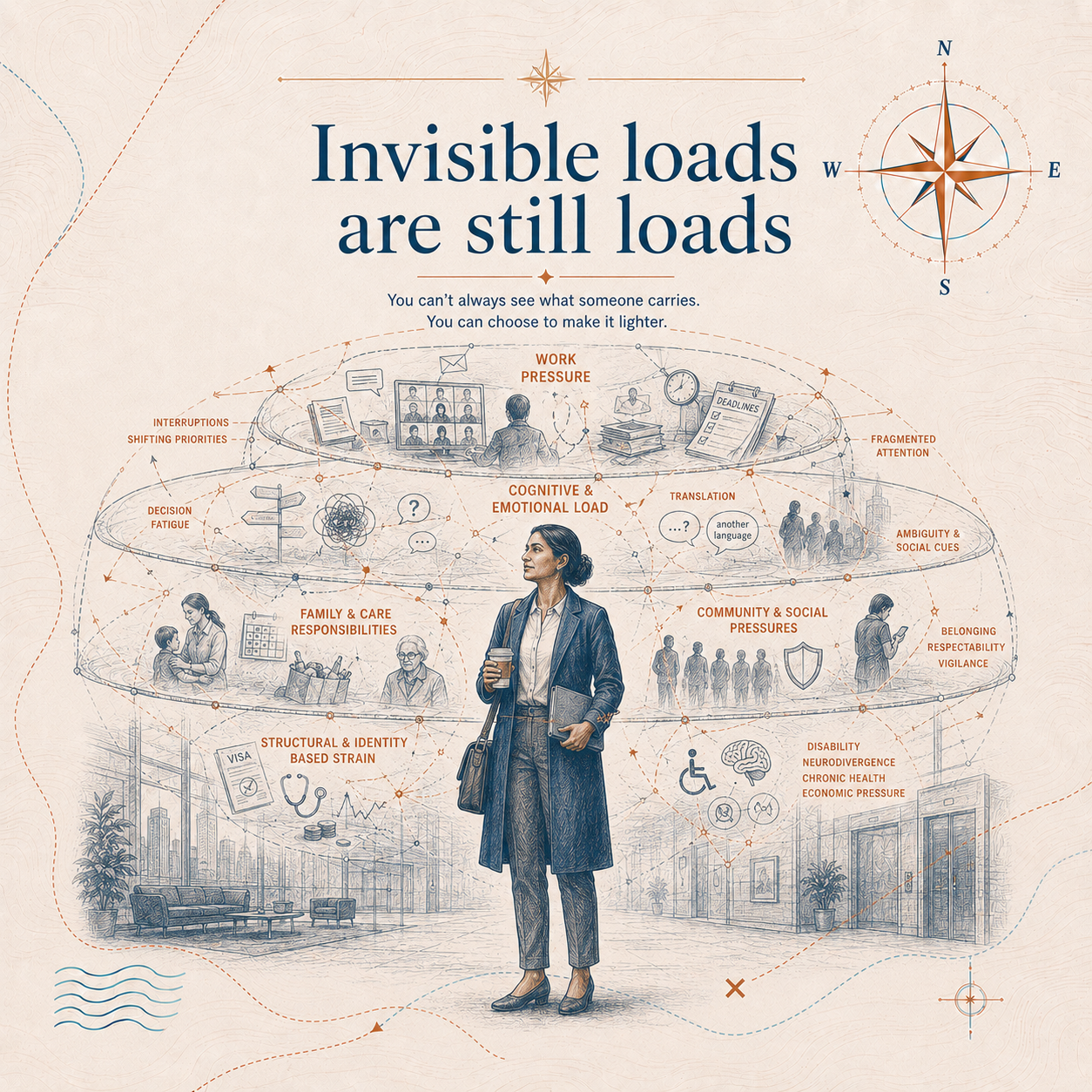
The web of pressures on individuals, often invisible to organisations
What neurodivergent friction can reveal
Modern work often makes invisible demands appear normal. But “normal” has long been a dangerous word for neurodivergent people.
Working in “normal” organisations often means dealing with ambiguous priorities, constant context switching, scattered communication, sensory overload, unclear social expectations, performative availability and obscure organisational politics.
Many neurodivergent people experience these demands more intensely because they place greater strain on executive functioning, sensory processing, emotional regulation and cognitive capacity.
Their struggles are often framed as personal deficits, so the response is directed towards the individual. Coaching and personal strategies may help, while adjustments can remove barriers.
But what if the difficulty also contains information about the system itself?
Neurodivergent professionals can be among the first to notice what organisations have overlooked or normalised.
The meeting culture is incoherent. Communication norms reward speed over depth. Deep work has been replaced by constant interruption. Roles are too wide, too vague, under-resourced or too dependent on unspoken expectations. Organisational culture claims to value diversity yet penalise people for failing to perform a narrow version of cognitive “normality”.
Neurodivergent experiences vary widely, and friction can arise from the person, the role, the environment or the interaction between them. But that friction can still reveal something important about the system itself.
Sometimes people described as “too sensitive” are noticing the emotional weather.
Sometimes the person seeking clarity is revealing that the strategy isn’t clear.
Sometimes the person who’s frustrated by another pointless meeting is exposing a redundant meeting culture that everyone else has simply learned to endure.
Sometimes the person who burns out first is not the weakest person in the system but simply the first person whose mind and body refuse to keep subsidising an incoherent organisation.
To understand why this happens, we need to think differently about communication itself.
Communication is relational
Damian Milton's Double Empathy Problem is useful here because it reframes communication breakdowns between autistic and non-autistic people as relational difficulties rather than deficits located within autistic people.
Milton’s point is not to deny that autism can create difficulties. Rather, misunderstandings often emerge between people who are making sense of the world through different assumptions, expectations and communication norms.
Used carefully, that idea also offers a useful lens for understanding communication in complex organisations.
Many workplace problems aren't simply communication failures. They're failures of translation between different mindsets, roles, pressures and team cultures, made worse by the lack of time and attention needed for genuine understanding and empathy to emerge.
Neurodiversity-informed leadership is not simply about understanding ADHD or autism. It's about understanding that organisations are diverse cognitive ecosystems and that people are shaped by the systems they inhabit, both inside and outside work.
Minds don’t all process, prioritise, recover, infer, focus, relate or communicate in the same way.
Some people need verbal processing to think clearly. Others need silence. Some need written clarity before a meeting. Some find ambiguity energising while others find it cognitively costly. Some do their best thinking under pressure and some lose nuance when pressure rises. Some notice relational tension long before anyone else senses that something is wrong.
Leaders who are unaware of neurodiversity are missing a fundamental layer of human systems. This limits their ability to lead well in complexity.
The challenge is often not difference itself, but our ability to recognise and work with it.
The politics of recovery
We also need to be careful about who we picture when we talk about ambition.
Invisible loads are unevenly distributed. Some people begin the working day carrying demands that others never have to consider.
Leaders are often imagined as autonomous: financially secure, able-bodied, neurotypical, supported at home and free to recover when needed.
That is not the reality many people experience.
Ambition is shaped by disability, neurodivergence, health, caring responsibilities, economic security, race, gender and the wider conditions of a person’s life.
So the questions within organisations become sharper.
Whose ambition is supported, and whose is punished?
Whose recovery is permitted, and whose is not?
Whose wellbeing is protected, and whose is treated as expendable?
Who is expected to remain calm while carrying invisible loads?
This is not a side issue. It changes the conversation about performance.
A senior leader may be holding together a family system behind an immaculate professional front.
A neurodivergent founder may spend much of their cognitive energy making themselves legible and acceptable to funders, colleagues and customers.
A Black woman leading in a mostly white organisation may carry reputational vigilance her colleagues never see.
A migrant professional may navigate visa insecurity while appearing calm on calls.
Organisations often depend on people carrying these unequal loads without recognising them.
Many of these loads begin outside the workplace but shape energy, judgement and performance within it every day.
Family and community are performance infrastructure
Leadership writing often talks as if leaders are disembodied decision-making units.
They aren’t.
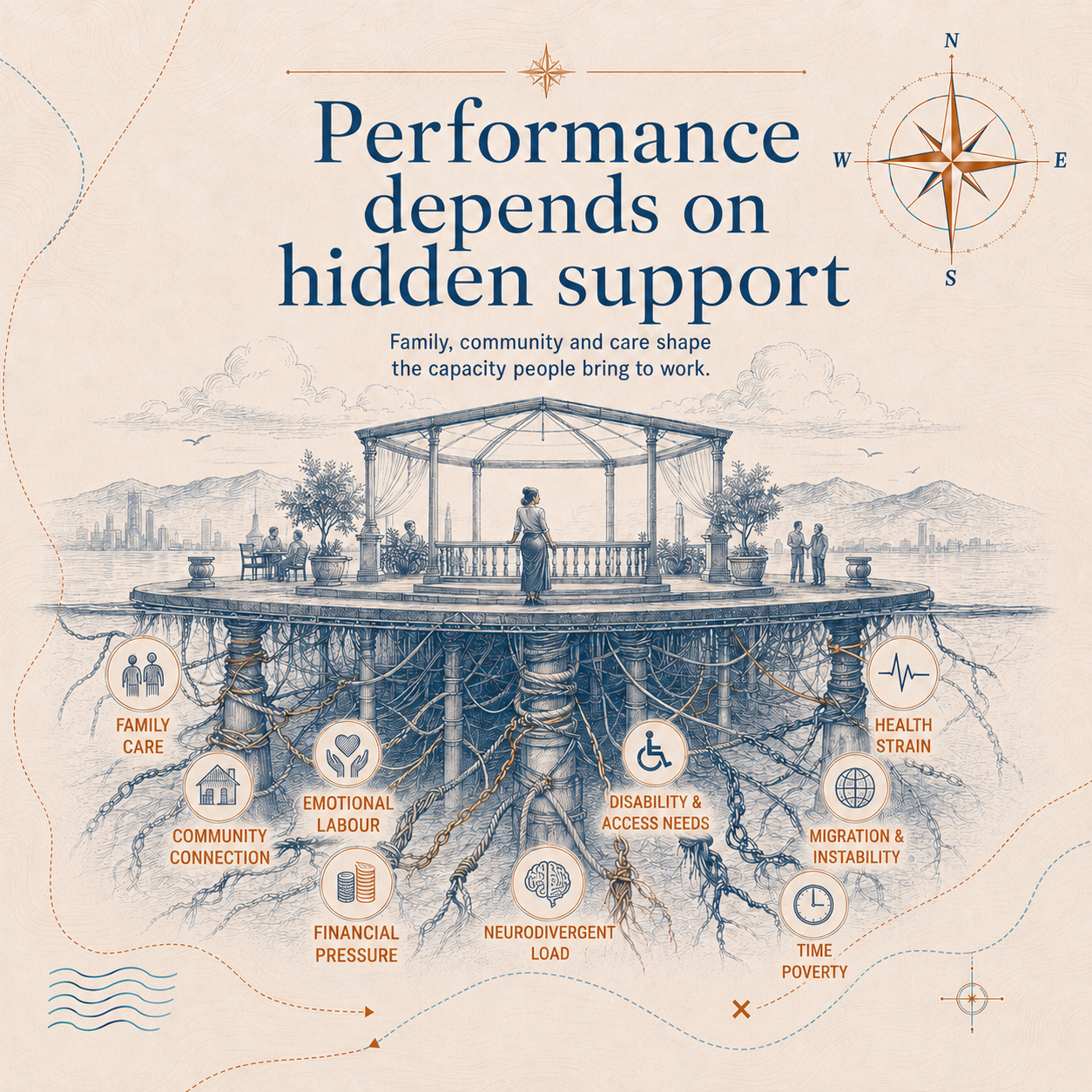
Performance often sits on hidden systems of care, community, health and access, while intersecting disadvantages increases load beneath the surface.
They’re people embedded in families, communities, care networks, histories, obligations and economic realities. These systems draw on and shape attention, regulation, energy, decision-making and recovery.
Family and community aren’t distractions from performance. They’re part of the ecology that makes performance possible.
Their value is not reducible to what they enable at work. But work cannot be understood accurately while pretending they have no effect on it.
Supportive relationships provide meaning, confidence, regulation and perspective. They help people return to themselves after difficult work. But when those relationships are strained or under-resourced, they can become a source of chronic background demand.
Parenting, eldercare, bereavement, relationship strain, financial pressure and community trauma rarely remain politely outside the office door.
They enter through the nervous system.
Through disrupted sleep.
Through the patience available when pressure rises.
Through the attention available when a difficult conversation lands at 6pm.
These pressures shape the attention, patience and judgement people can bring to work each day.
Any credible model of sustainable performance has to include this human ecology. Without it, organisations risk misreading both the capacity people have available and the conditions that make performance possible.
What organisations often fail to see
Organisations don’t need to know every private detail of a person’s life. That would be intrusive and inappropriate. Nor can they solve everything people carry outside work.
Invisible loads shape performance, whether organisations recognise them or not.
But they can avoid adding unnecessary friction, design work for human variability and interpret performance more intelligently.
Performance is not produced by individuals alone. It is shaped by the relationships, responsibilities, resources and conditions around them.
People don’t arrive at work as isolated productivity units. They arrive with bodies, histories, identities, obligations, nervous systems and different cognitive architectures.
When organisations design work as if these realities don’t exist, they misread both people and performance.
They may call someone inconsistent when they’re overloaded.
They may call someone difficult when they’re asking for clarity.
They may call someone disengaged when they’re protecting what remains of their capacity.
They may call someone resilient when they’re masking collapse.
They may celebrate composure while depending on self-erasure.
This is why neurodiversity and intersectionality are essential to understanding sustainable performance.
Sustainable performance depends not only on what organisations measure, but on what they are capable of noticing.
But noticing is only the beginning. The next question is what it would mean to design ambition that protects and grows future capacity rather than consuming it.
References & Influences
Kimberlé Crenshaw, Demarginalizing the Intersection of Race and Sex
What invisible loads are shaping performance in your organisation?
I work with leaders, teams and organisations to make hidden pressure, working patterns and capacity more visible.
Arlene K. Daniels, “Invisible Work”
Nancy Doyle and Almuth McDowall, Neurodiversity Coaching: A Psychological Approach to Supporting Neurodivergent Talent and Career Potential
Arlie Russell Hochschild, The Managed Heart
Arlie Russell Hochschild and Anne Machung, The Second Shift
Damian E.M. Milton, On the Ontological Status of Autism: the 'Double Empathy Problem'
Damian Milton, Emine Gurbuz and Beatriz López, The 'Double Empathy Problem': Ten years on
CIPD, Neuroinclusion at Work Report, 2024
Michał T. Tomczak and Konrad Kulikowski, Toward an Understanding of Occupational Burnout Among Employees with Autism: The Job Demands–Resources Theory Perspective